
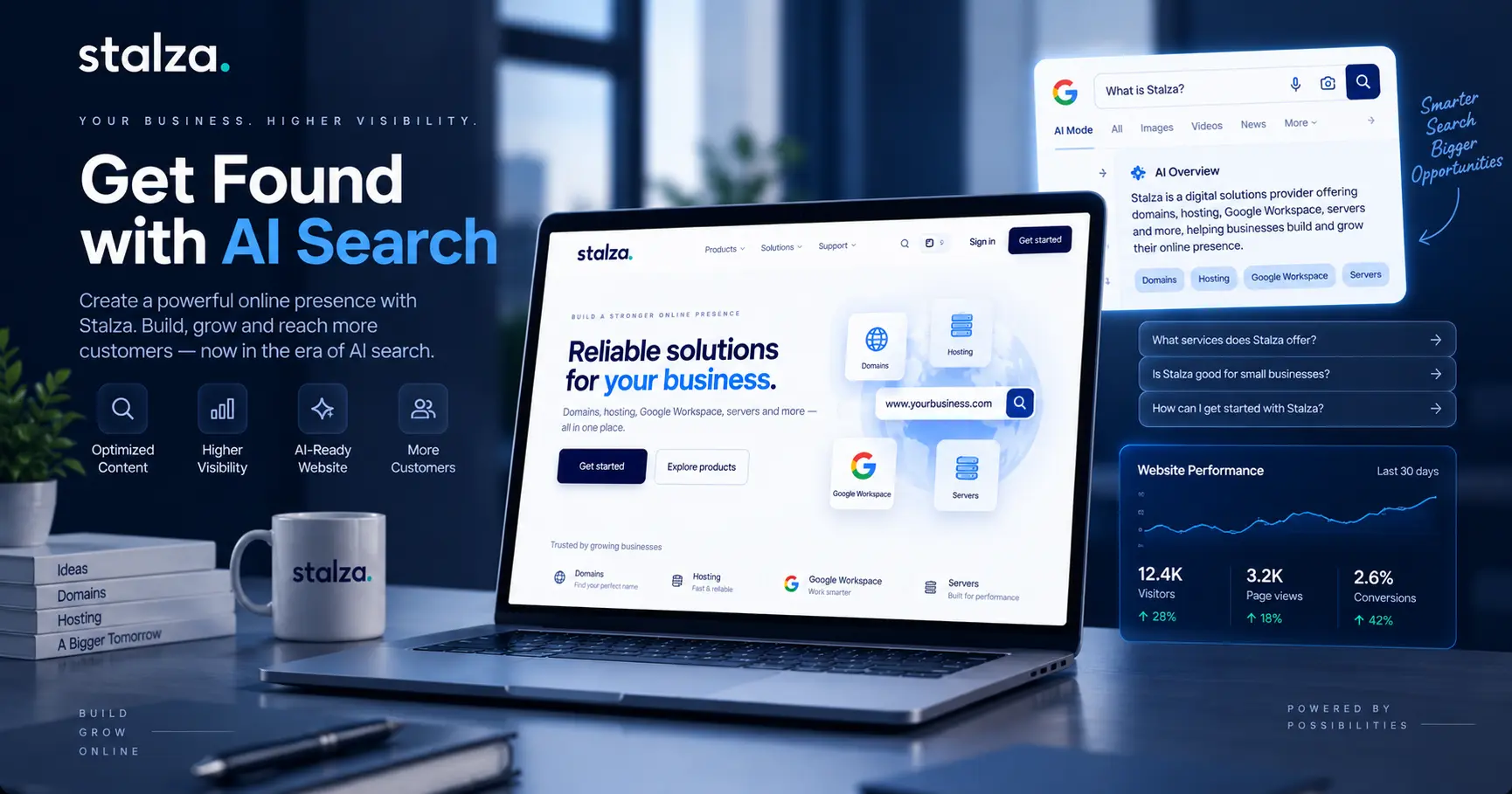
Search is becoming less about typing a few keywords into a search box and scanning ten blue links.
People are increasingly asking longer, more specific questions and expecting search engines to understand the context behind those questions.
Google has been moving in this direction with AI Overviews and AI Mode. In 2026, Google is continuing to expand these experiences, including more ways for users to explore information and discover relevant websites and original content.
For small businesses, this creates both a challenge and an opportunity.
Your website still matters. Your content still matters. SEO still matters.
But the way people discover that content is changing.
What is AI search?
AI search uses generative AI to understand a user's question, gather information and provide a more conversational response.
Instead of simply returning pages that contain matching keywords, AI-powered search can interpret questions, connect related concepts and help users explore a topic through follow-up questions.
Google's AI Overviews and AI Mode are examples of this evolution.
This does not mean traditional search has disappeared. It means businesses now need to think about both traditional search visibility and visibility within AI-powered search experiences.
Why this matters to small businesses
Imagine someone searches:
"What's the best website hosting option for a small business in India?"
A traditional search experience may show a list of websites.
An AI-powered search experience may instead provide an explanation, compare options and recommend sources that support the answer.
If your website is one of those sources, you have another opportunity to reach a potential customer.
The important question is therefore no longer simply:
"How do I rank number one?"
It is increasingly:
"How do I become a useful, trustworthy source that search engines can understand and reference?"
Your website is still the foundation
One of the biggest mistakes businesses can make is assuming AI search means websites are becoming less important.
The opposite is closer to reality.
Your website is where your business information lives.
It contains your:
Products and services
Pricing information
Company information
Expertise
Guides and resources
Contact information
Customer support content
Original research
Case studies
Google's own guidance around generative AI search continues to emphasize established SEO fundamentals while encouraging websites to provide useful, original and non-commodity content.
Create content that answers real questions
AI-powered search is particularly useful for conversational questions.
That means businesses should move beyond articles created solely around short keywords.
Instead of writing:
"Web Hosting"
you could create:
"How Much Hosting Does a Small Business Website Actually Need?"
Instead of:
"Business Email"
create:
"Should Your Business Use Gmail or a Professional Business Email Address?"
Instead of:
"Domain Name"
create:
"How Do I Choose the Right Domain Name for My Business?"
These topics address actual problems.
That makes them useful to humans and easier for search systems to understand.
Original information matters more than generic content
One of the biggest opportunities in AI search is publishing information that cannot easily be replaced by thousands of similar articles.
For Stalza, that could include:
Hosting performance tests
Website migration experiences
Domain industry explanations
Real-world server comparisons
Small-business technology guides
Google Workspace tutorials
Security checklists
Customer use cases
Infrastructure explainers
A generic article saying "hosting is important for your website" adds very little.
A detailed guide explaining how hosting performance affects WordPress websites, what resources different websites actually need and how to identify bottlenecks is much more valuable.
Make your content easy to understand
Good AI-search content does not need to be written for machines.
Write for people first.
Use:
Clear headings
Short paragraphs
Direct answers
Lists where appropriate
Tables for comparisons
Definitions for technical terms
Examples
Supporting evidence
Useful FAQs
The goal is to make the information easy to understand and easy to navigate.
Don't chase every AI SEO acronym
You will see plenty of articles discussing AEO, GEO, LLMO and other terms.
Some are useful concepts. Others are largely marketing terminology.
Google's own guidance makes an important point: there isn't a secret technical trick that guarantees inclusion in AI search results. Traditional SEO fundamentals continue to matter.
That means businesses should be cautious about anyone promising:
"Guaranteed AI search rankings."
Instead, focus on building something genuinely useful.
Build topic authority
A single article rarely establishes expertise.
A better strategy is to build clusters of related content.
For example, a hosting cluster could include:
What Is Web Hosting?
How Much Hosting Does a Small Business Website Need?
Shared Hosting vs VPS Hosting
How to Improve Website Loading Speed
How to Move a Website to a New Host
How Website Hosting Affects SEO
How to Secure Your Web Hosting Account
These articles can link to one another.
Together, they demonstrate that your website understands the subject rather than simply publishing isolated articles.
AI search doesn't replace SEO
This is probably the most important takeaway.
You don't need to abandon SEO because AI search exists.
You need to build on it.
Technical SEO, useful content, website performance, internal linking, structured information and authority remain important foundations.
AI search simply introduces another way people may discover that information.
What should small businesses do now?
Start with five things.
Improve your website
Make sure your website clearly explains what you do, who you serve and what you offer.
Publish genuinely useful content
Answer the questions your customers actually ask.
Build topic clusters
Don't publish unrelated articles. Build depth around subjects relevant to your business.
Add original insights
Share experiences, comparisons, data and practical knowledge that generic AI-generated articles cannot easily reproduce.
Keep your content maintained
Technology changes quickly. Review important articles regularly and update outdated information.
The future belongs to useful websites
AI may change how people search, but it doesn't eliminate the need for good information.
In fact, it may increase the value of websites that provide trustworthy, original and genuinely useful information.
For small businesses, the opportunity is straightforward:
Build a website worth discovering. Build content worth referencing. Build a business worth trusting.
AI search is still evolving. The businesses that invest in strong digital foundations now will be in a much better position as search continues to change.